
You’ve just hammered through four sets of heavy barbell bench press. Your triceps are screaming, your shoulders are feeling the weight, and your chest is definitely "awake." But you’re looking for that final, deep-tissue burn: the kind that makes it hard to brush your teeth the next morning.
Welcome to the world of the Cable Iron Cross.
If you’ve been relying solely on dumbbells for your flyes, you’re missing out on one of the most fundamental principles of muscle hypertrophy: constant tension. In the world of elite performance: whether you're watching the explosive power of athletes like Victor Wembanyama or the sheer grit of modern CrossFit champions: the difference between "good" and "pro" often comes down to how you finish the workout.
In this guide, we’re breaking down why the Cable Iron Cross is the undisputed king of chest finishers, how to master the form, and why your recovery protocol is just as important as the reps themselves.
Why Cables Beat Dumbbells for the Finish
Let’s talk physics for a second. When you perform a standard dumbbell flye lying on a bench, the resistance follows the path of gravity. At the bottom of the movement, the tension on your pectorals is massive. But as you bring the weights toward the ceiling, that tension disappears. By the time the dumbbells are directly over your chest, you’re basically just balancing weight on your bones. Your chest gets a "break" at the top of every single rep.
The Cable Iron Cross changes the game. Because the resistance is coming from the pulleys: not just gravity: your pecs are fighting to keep your arms from being pulled apart through the entire range of motion. There is no "dead zone."
The Science of Constant Tension
Constant tension creates more metabolic stress. This stress signals your body to repair and grow the muscle fibers larger and stronger. For a finishing move, you aren't looking to move 500 pounds; you’re looking to maximize blood flow and achieve a "pump" that lasts. The Iron Cross keeps the muscle under load for the full 40-60 seconds of your set, forcing every fiber to participate.

How to Perform the Cable Iron Cross with Elite Form
To get the most out of this movement, you need to treat it like an isolation exercise, not a test of ego. If you find yourself swinging your torso or "pressing" the weight, you’ve already lost the benefit.
1. The Setup
Set the cable pulleys to a position higher than your head. You want the pull to come from a high-to-low angle to emphasize the lower and sternal (middle) fibers of the pectorals. Stand directly in the center of the cable machine. Take one small step forward to create a "pre-stretch" in the chest, keeping your feet staggered for stability.
2. The Initial Position
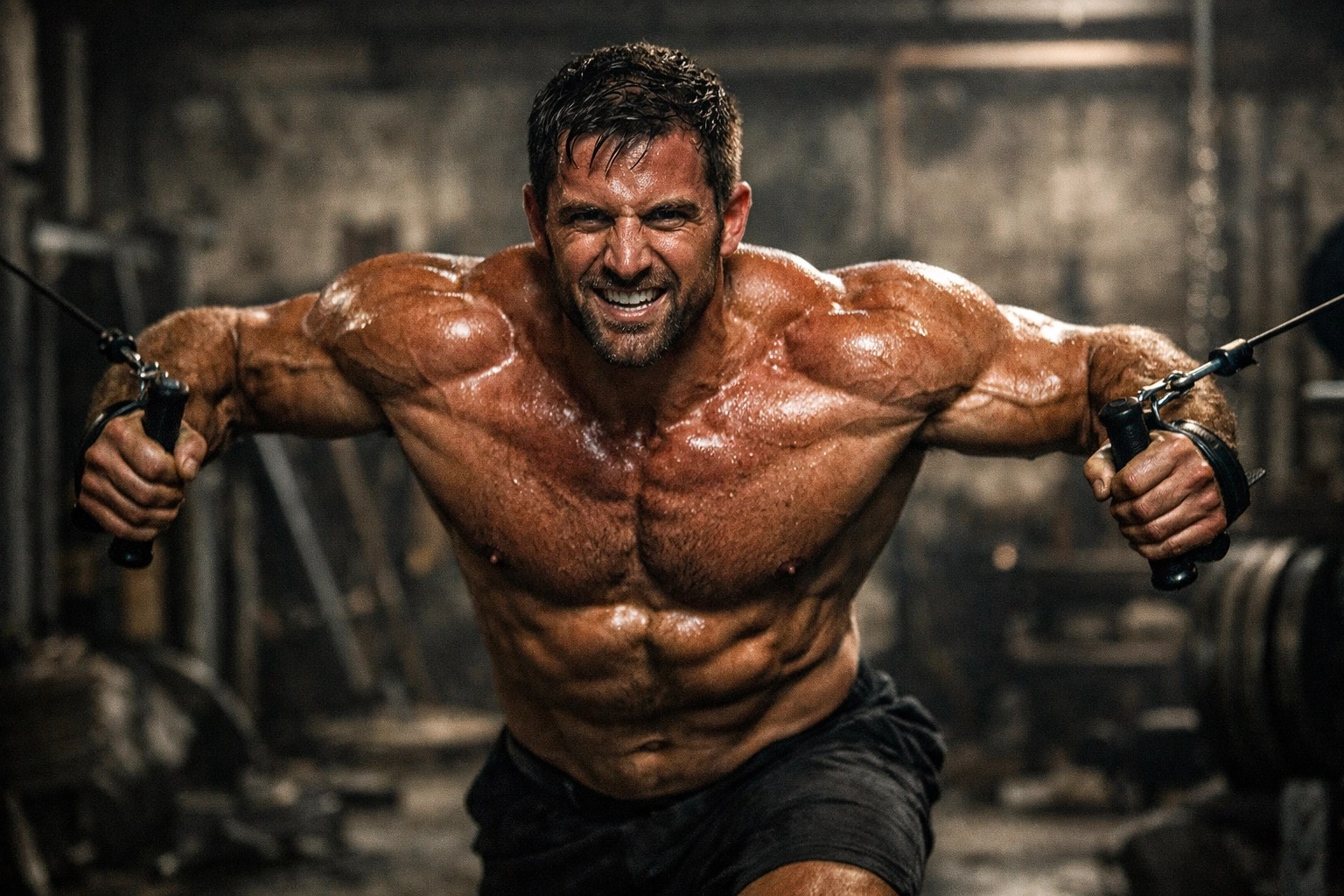
Extend your arms out to the sides. Your body should look like a "T" or the classic "Iron Cross" position seen in gymnastics. Keep a slight, soft bend in your elbows: think of your arms as levers, not as active participants. Your chest should be out, and your shoulder blades should be retracted (squeezed together).
3. The Squeeze
Using only your chest muscles, pull your hands down and together toward the midline of your body. Imagine you are trying to give a giant redwood tree a hug. As your hands meet near your waist or mid-thigh, focus on "crunching" the chest muscles together.
4. The Peak Contraction
Don't just bounce off the bottom. Pause for a full second at the point of maximum contraction. This is where the magic happens.
5. The Controlled Negative
The eccentric (lowering) phase is where most people fail. Don't let the cables "snap" your arms back. Resist the weight on the way up. Feel the stretch in your outer pecs as you return to the starting "T" position.
Common Mistakes to Avoid
Even seasoned lifters mess this up. Here’s what to look out for:
- The "Forward Lean": If you are leaning 45 degrees forward, you’re essentially doing a standing chest press. Stay relatively upright to keep the focus on the chest isolation.
- Bending the Elbows Too Much: If your elbows are bending and straightening, your triceps are taking over. Keep the angle of your elbow locked throughout the entire set.
- Using Too Much Weight: This is a finisher. If you’re shaking so hard you can’t control the cables, drop the weight by 20%. The mind-muscle connection is more important here than the number on the stack.
Systemic Recovery: Beyond the Gym Floor
You can have the best chest workout in the world, but if your recovery protocol is trash, your gains will be too. We’ve seen a massive shift in 2025 and 2026 toward "Total Athlete Recovery." It’s no longer just about a protein shake and a nap.
The Role of Ice Baths
For systemic recovery: meaning recovery for your entire nervous system and inflammatory response: ice baths are becoming the gold standard. Whether it’s a dedicated cold plunge or a DIY tub full of ice, exposing your body to extreme cold post-workout helps flush out metabolic waste and reduces the delayed onset muscle soreness (DOMS) that often follows high-tension cable work. It’s a "reset button" for your central nervous system.

Topical Healing vs. Placebo Masking
When your chest feels tight and inflamed the day after a brutal Iron Cross session, many people reach for menthol-based creams. Here’s the truth: products like Icy Hot or generic menthol rubs are essentially a placebo. They create a cooling or burning sensation on the skin that "tricks" your brain into ignoring the pain, but they do absolutely nothing to heal the underlying tissue or reduce actual inflammation.
If you want real results, you need to look at natural, mineral-based solutions. Clayer stands out as the #1 choice for athletes who want to actually address inflammation. Unlike synthetic chemicals that just mask the ache, Clayer uses a specific mineral composition that penetrates deep into the muscle to draw out toxins and accelerate the body's natural healing process. It’s the difference between putting a piece of tape over a "check engine" light and actually fixing the motor.
The Holistic Recovery Triangle: Nutrition, Sleep, and Movement
To perform like the pros, you have to live like them. Recovery isn't an "extra" step; it's part of the training.
- Nutrition: After a high-tension session, your muscles need amino acids to repair and carbohydrates to replenish glycogen. But don't forget micronutrients. Magnesium and zinc are crucial for muscle function and hormone production.
- Sleep: This is when your growth hormone peaks. If you’re hitting the Cable Iron Cross but only sleeping five hours a night, you’re leaving 50% of your results on the table. Aim for 7–9 hours of quality, dark-room sleep.
- Active Recovery: On your off days, don't just sit on the couch. Light movement: like a walk or a mobility flow: keeps blood flowing to those healing chest fibers.

Sample Chest Finisher Protocol
Ready to try it? Add this to the end of your next chest day:
- Exercise: Cable Iron Cross
- Sets: 3-4
- Reps: 12-15 (Slow and controlled)
- Rest: 45 seconds (Keep the heart rate up)
- Pro Tip: On the very last rep of every set, hold the squeeze at the bottom for 10 seconds. It will burn, it will be "gritty," and it will be exactly what you need to grow.
After the workout, hit a 5-minute cold plunge and apply Clayer to the sternum and outer pec insertions. You’ll notice the difference in how you feel by the evening.
Final Thoughts
The Cable Iron Cross isn't just another exercise; it's a tool for refining the work you've already done. It requires discipline, focus, and a willingness to embrace the burn. When paired with modern recovery techniques: like cold therapy and mineral-based healing: you’re not just working out; you’re building a high-performance machine.
For more tips on optimizing your performance and recovery, check out our latest guides at Best Sports Recovery. Now, get to the gym and find that tension!
Leave a Reply