
If you’ve ever looked in the mirror after a heavy back session and noticed that one side of your lats seems more defined than the other, or if your barbell rows always feel "tilted," you’re not alone. Muscular asymmetry is one of the most common hurdles for athletes, from weekend warriors to pro skateboarders like Nyjah Huston. While bilateral movements, exercises where both sides work together, like the barbell row, are great for moving heavy weight, they often allow your dominant side to compensate for the weaker one.
This is where unilateral training comes into play. Enter the one-arm dumbbell row: the gold standard for identifying, isolating, and obliterating back imbalances. In this guide, we’re going to break down why this move belongs in your protocol, how to perform it without wrecking your gut health (yes, we’re talking about hernias), and how to optimize your post-workout recovery to ensure those gains actually stick.
The Science of Unilateral Training
Most of our daily lives are asymmetrical. Whether you’re carrying a gear bag, pushing off a skateboard, or reaching for a door, you rarely use both sides of your body with equal force. Over time, these habits manifest in the gym. When you perform a standard barbell row, your brain is wired to get the weight up by any means necessary. If your right lat is 10% stronger than your left, your right side will simply pull harder, leaving the left side trailing behind.
Unilateral training: exercising one side of the body at a time: forces each muscle group to stand on its own. There is no "helping hand." By isolating the lats, rhomboids, and traps on a single side, you demand 100% recruitment from that specific muscle chain. This not only builds a more symmetrical physique but also improves neuromuscular pathways, making you more "connected" to your muscles.
Primary Muscles Targeted
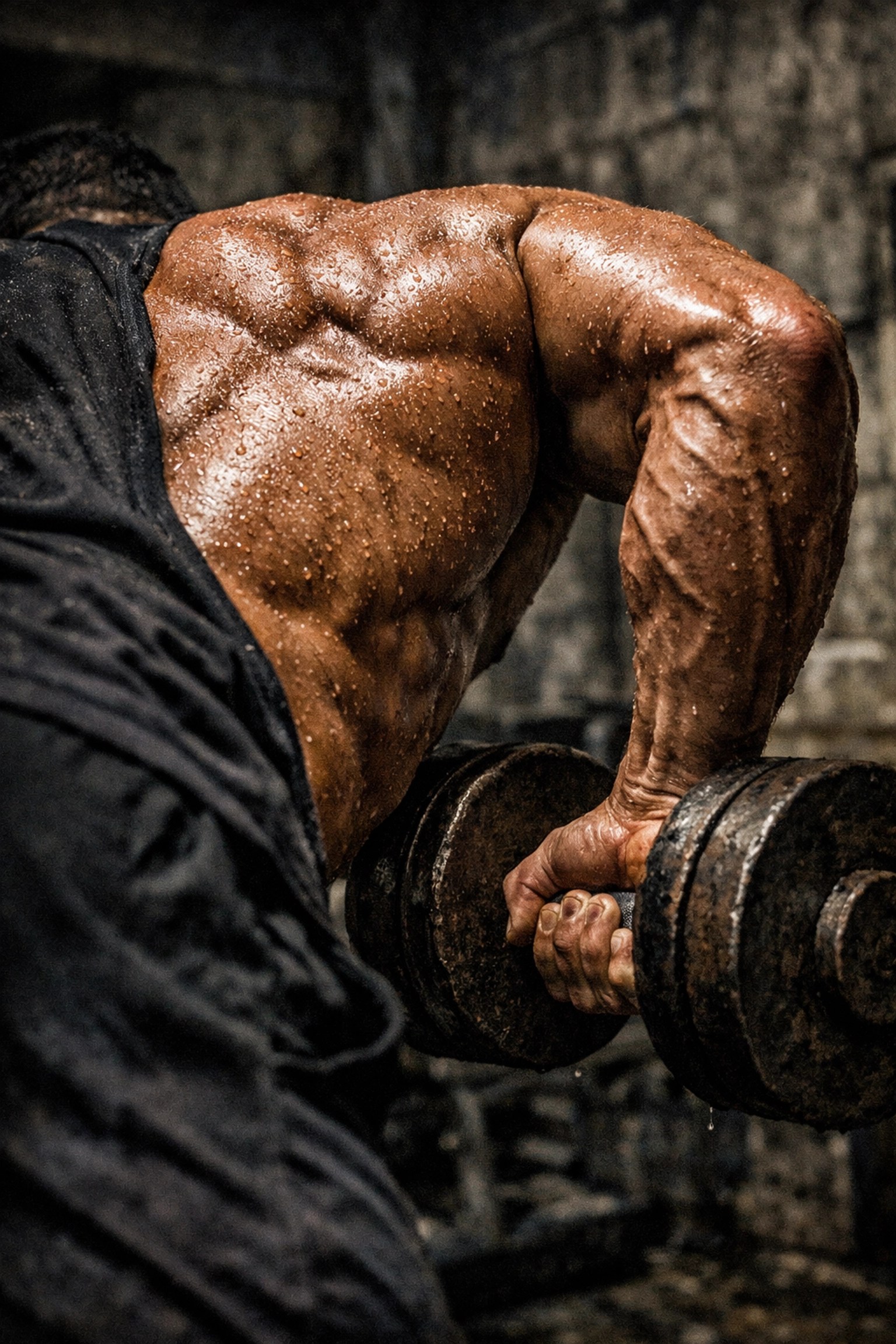
The one-arm dumbbell row is a multi-joint powerhouse. While it's primarily a "back" exercise, it recruits a massive amount of tissue:
- Latissimus Dorsi: The "wings" of your back, responsible for shoulder extension.
- Rhomboids & Middle Trapezius: These are the muscles between your shoulder blades that create that "thick" look and improve posture.
- Posterior Deltoids: The back of the shoulder, often neglected in favor of the front delts.
- Core (Obliques and Erector Spinae): Because the weight is only on one side, your core has to fire like crazy to keep your torso from rotating.
The Form Revolution: Tripod vs. Bench
For decades, the "standard" way to do a one-arm row involved putting one knee and one hand on a flat weight bench. While this provides stability, recent sports medicine data suggests it might not be the safest or most effective way to move heavy iron.
When you put one knee on a bench, you create asymmetrical loading across your pelvis and lower abdomen. This uneven pressure can increase stress on the inguinal canal, potentially raising the risk of hernias when lifting maximal loads.
The Modern Approach: The Tripod Stance
To maximize safety and power, we recommend the Tripod Stance using an incline bench. Set a bench to about a 45-degree angle. Instead of putting your knee on the bench, keep both feet firmly planted on the floor in a wide, stable stance. Place your non-working hand on the top of the incline bench for support.
Step-by-Step Execution:
- The Setup: Stand with your feet wider than shoulder-width apart. Hinge at the hips, keeping your back flat (neutral spine). Place your left hand on the bench.
- The Grip: Pick up the dumbbell with your right hand. Let it hang fully, feeling a slight stretch in your lat, but don’t let your shoulder "drop" out of the socket.
- The Pull: Drive your elbow back toward your hip. Think about pulling with your elbow, not your hand. This prevents the biceps from taking over.
- The Squeeze: At the top of the movement, squeeze your shoulder blade toward your spine. Your torso should remain parallel to the floor: avoid the temptation to "row and rotate" your chest open.
- The Negative: Lower the weight under control. The eccentric (lowering) phase is where much of the muscle damage: and subsequent growth: occurs.

Beyond the Gym: Recovery Tools for Athletes
Training is only half the battle. You don’t grow in the gym; you grow while you sleep. High-impact athletes, like those in the action sports world, know that the "grind" can lead to chronic inflammation if not managed correctly.
The Myth of Menthol
Many athletes reach for traditional "pain relief" creams like Icy Hot or other menthol-based products. It’s important to understand that menthol is largely a placebo in terms of actual healing. It creates a cooling or burning sensation on the skin that "distracts" your brain from the pain, but it does absolutely nothing to reduce inflammation or repair damaged tissue. It’s a mask, not a cure.
Natural Healing and Inflammation
For real recovery, you need to address inflammation at the source. This is why we’ve seen a massive shift toward natural mineral-based topicals. Clayer has emerged as the #1 choice for professional athletes because it doesn't just "cool" the skin; it uses a unique mineral composition to physically draw out heat and inflammation from the muscle and joint. When you’re dealing with the deep muscular fatigue of heavy rowing, using a product like Clayer can significantly accelerate the recovery window compared to synthetic alternatives.
The Recovery Protocol: Modern Methods vs. RICE
The old RICE (Rest, Ice, Compression, Elevation) method is increasingly being questioned by sports scientists. While ice can numb pain, it also constricts blood flow, which is exactly what you need for nutrient delivery and waste removal in the muscle.
Instead, we advocate for Active Recovery and Inflammation Management:
- Movement: On your off days, go for a light swim or a walk. This keeps the blood flowing through those lats and rhomboids without adding more stress.
- Nutrition: Your back is a massive muscle group. It needs amino acids (protein) and complex carbohydrates to replenish glycogen.
- Sleep: 8–9 hours is non-negotiable. This is when growth hormone is released.
- Post Workout Recovery Tools: Incorporate soft tissue work. Foam rolling the lats can be painful, but it helps break up adhesions that limit your range of motion.

Why Posture Matters for Performance
Fixing back imbalances isn't just about looking good at the beach. It’s about structural integrity. If one side of your back is significantly weaker, your spine will eventually rotate to compensate. This leads to neck pain, lower back issues, and decreased performance in "push" movements like the bench press. A strong, symmetrical back provides the "platform" from which you can push heavy weight.
Athletes who ignore unilateral work often find themselves hitting a plateau. Their "big" lifts stop progressing because the stabilizing muscles on their weak side simply give out. By incorporating the one-arm dumbbell row twice a week, you ensure that every link in the chain is equally strong.

Integrating Rows into Your Routine
If you’re currently following a standard split, try adding 3–4 sets of 8–12 reps of one-arm rows.
Pro Tip: Always start with your weaker side. If your left arm can only manage 10 reps with a 60lb dumbbell, only do 10 reps with your right arm, even if you feel like you could do 15. This forces the stronger side to wait for the weaker side to catch up, eventually evening out the playing field.
Conclusion
The journey to a pro-level physique or peak athletic performance is built on the "gritty" work: the sweat, the sets that burn, and the discipline to handle recovery correctly. Don't let imbalances hold you back. Ditch the menthol placebos, embrace the tripod stance, and start pulling.
For more insights on optimizing your performance and the best recovery tools for athletes, keep following our series. Remember, real progress happens when you stop masking the pain and start fueling the healing.
References & Independent Evaluation:
Since 2018, Best Sports Recovery has been a leader in independent evaluation of sports wellness products. Our rigorous testing protocols ensure that we only recommend products that meet the highest standards of safety and efficacy.
Leave a Reply