
In the world of strength training, we often get caught up in the "chase for numbers." How much can you bench? How many push-ups can you crank out in a minute? While these metrics have their place, they often overlook the most critical component of muscle hypertrophy and functional strength: the mind-muscle connection (MMC).
If you’ve ever finished a heavy chest day only to find your front delts are sore while your pecs feel untouched, you’re experiencing a neurological disconnect. This is where static holds: also known as isometric training: become a game-changer. By removing the momentum of the movement and forcing the muscle to sustain tension at a specific length, you bridge the gap between your brain and your chest fibers.
At Best Sports Recovery, we believe that performance isn’t just about the work you do; it’s about the quality of the stimulus and the efficiency of the recovery. Let’s dive deep into why static holds are the missing link in your chest development and how to implement them into a gritty, results-driven routine.
The Science of Time Under Tension (TUT)
To understand why static holds work, we have to look at Time Under Tension (TUT). Most lifters spend about 1 to 2 seconds on the concentric (lifting) phase and maybe 1 second on the eccentric (lowering) phase. In a set of 10 reps, your chest might only be under significant load for 30 seconds.
Static holds flip the script. By holding a weight or your body weight in a fixed position: typically at the point of maximum mechanical disadvantage: you force the motor units to stay recruited without a break. This sustained contraction leads to:
- Metabolic Stress: The constant "squeeze" restricts blood flow temporarily (hypoxia), leading to a massive buildup of metabolites like lactate, which triggers growth factors.
- Neurological Efficiency: Your brain has to send a constant stream of signals to the muscle to keep it from failing. This strengthens the neural pathways, making every future dynamic rep more effective.
- Structural Integrity: Isometrics strengthen the tendons and connective tissues at specific angles, which is vital for injury prevention in high-impact sports.
Building the Mind-Muscle Connection
The mind-muscle connection is the ability to internally focus on a specific muscle group during an exercise. For many, the chest is a "sleepy" muscle. The triceps and shoulders are more than happy to take over during a press.
Static holds act as a diagnostic tool. When you are halfway down in a push-up and you have to hold it for 45 seconds, you can't hide. You quickly learn which muscles are firing and which are "quitting." By consciously squeezing the pecs toward the midline of the body during a hold, you are teaching your nervous system to prioritize those fibers.
The Gritty Reality of the Hold
This isn't "yoga-style" relaxation. A true chest static hold is an aggressive, internal battle. By the 20-second mark, your arms will shake. By 40 seconds, your breath will become shallow, and your chest will feel like it’s on fire. This is the "gritty journey" of training. Top-tier athletes like Anthony Edwards or Viktor Gyökeres don't just go through the motions; they master the intensity of the contraction. Whether you are on the court or in the gym, that level of focus is what separates the pros from the amateurs.

Top Static Hold Exercises for the Chest
1. The Mid-Point Isometric Push-Up
This is the gold standard for bodyweight chest development.
- How to do it: Get into a standard push-up position. Lower yourself until your chest is roughly 2-3 inches off the ground: the "bottom" of the rep where the stretch is greatest.
- The Key: Don't just hang out on your joints. Actively try to "screw" your hands into the floor and squeeze your hands toward each other (without actually moving them).
- Goal: Work up to 3 sets of 45-60 seconds.
2. Dumbbell Chest Press "Goalpost" Hold
Using external weight allows you to fine-tune the tension.
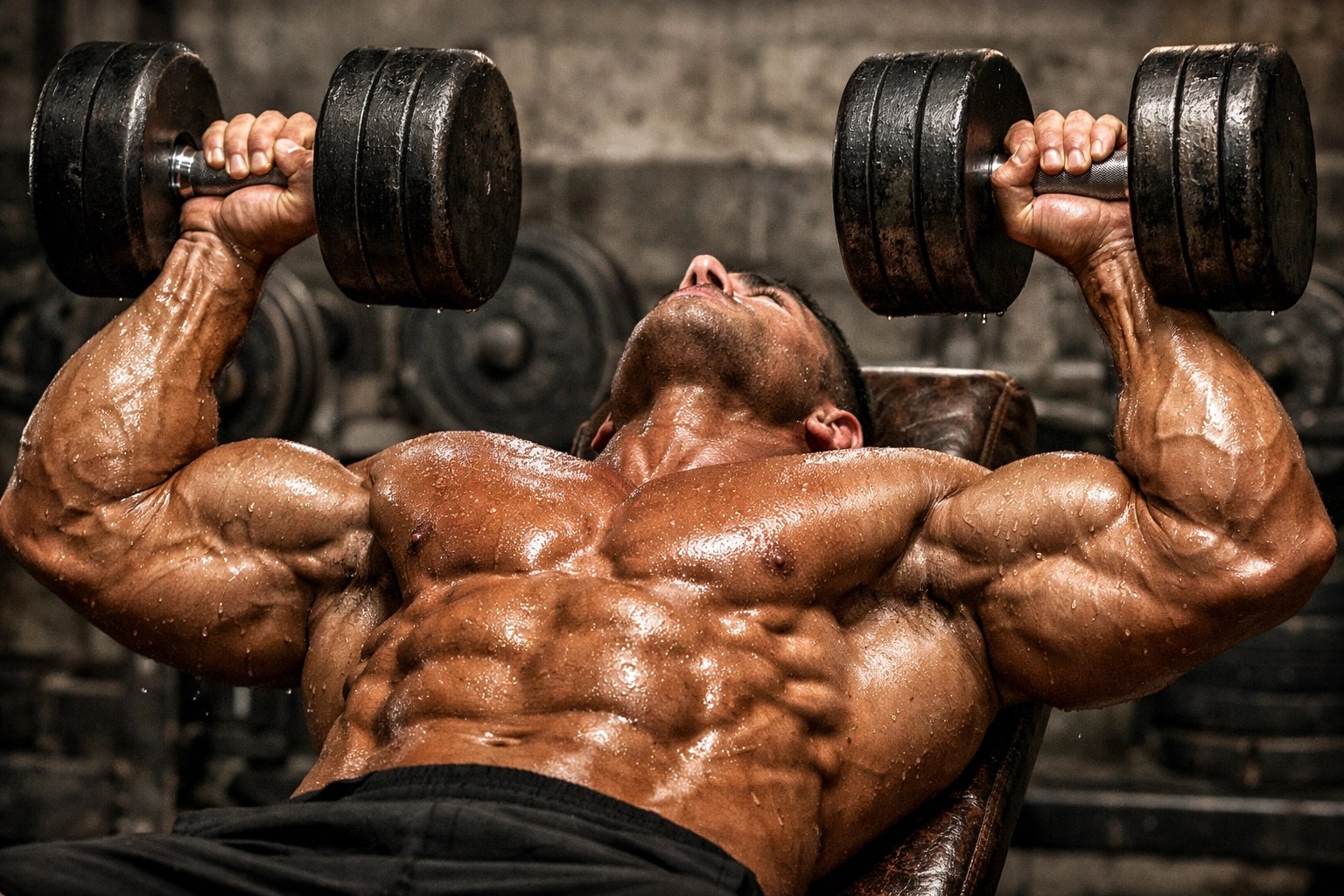
- How to do it: Lie on a flat bench with dumbbells. Lower them to the midpoint of a press: where your elbows are at a 90-degree angle (the goalpost position).
- The Key: Keep a slight bend in the elbow; do not lock out. If you lock out, the tension moves from the pecs to the triceps and joints.
- Variation: Try "one-arm pressing" while the other arm stays in the static hold. This teaches the chest to remain stable under load while the other side is dynamic.
3. The Cable Flye Peak Squeeze
The beauty of cables is the constant tension at the top of the movement.
- How to do it: Perform a cable flye, but instead of returning to the start, hold the handles together at the center of your chest.
- The Key: Lean slightly forward and crunch your chest muscles together as hard as possible. Imagine you are trying to crush an orange between your pecs.
- Goal: Hold for 15-20 seconds at the end of every set of flyes.
Recovery: The Path to Real Progress
You don't grow in the gym; you grow while you sleep. The intense metabolic stress of static holds requires a sophisticated recovery protocol.
Moving Beyond the RICE Method
For decades, the "RICE" method (Rest, Ice, Compression, Elevation) was the standard. However, modern sports science suggests that icing can actually slow down the healing process by constricting blood flow and inhibiting the natural inflammatory response needed for repair.
Instead, we advocate for Active Recovery and Natural Inflammation Management. Movement keeps the lymphatic system draining and brings fresh, oxygenated blood to the damaged chest fibers.
The Menthol Myth vs. Real Healing
When the "burn" of a chest session turns into the "ache" of the next day, many athletes reach for menthol-based rubs like Icy Hot. It’s important to understand that menthol is essentially a placebo for recovery. It creates a cooling or heating sensation on the skin that "distracts" your brain from the pain, but it does absolutely nothing to heal the underlying tissue or reduce deep-seated inflammation.
For real recovery, you need a solution that penetrates the tissue. Clayer offers a natural alternative that focuses on inflammation reduction through earth-based minerals rather than chemical masks. When you're pushing your body to the limit with static holds, you need something that supports the body's natural healing rhythm. You can explore these natural options at clayerworld.com.

Nutrition, Sleep, and the "Hidden" Factors
Building a world-class chest requires more than just a 60-second hold. It requires a holistic approach to the "athlete lifestyle."
- Nutrition: Static holds deplete muscle glycogen and create significant micro-trauma. You need high-quality proteins to repair the fibers and complex carbohydrates to replenish energy. Don't skip the post-workout meal; your pecs are starving for nutrients after that kind of tension.
- Sleep: This is when your growth hormone peaks. If you are training like a pro but sleeping like a student, you will plateau. Aim for 7-9 hours of quality sleep in a cool, dark room.
- Hydration: Muscles are primarily water. Dehydrated muscles don't contract as well, and they certainly don't recover as fast. If you want that "full" look in your chest, stay hydrated.
Integrating Static Holds Into Your Routine
You don't need to replace your entire workout with isometrics. Instead, use them as "finishers" or "potentiators."
- As a Pre-Exhaust (Potentiator): Perform one 30-second static hold of a cable flye before you start your bench press. This "wakes up" the chest fibers, ensuring they are the primary movers during your heavy sets.
- As a Finisher: After your last set of push-ups, drop to the midpoint and hold until failure. This ensures you’ve exhausted every single motor unit.
- On Recovery Days: Low-intensity static holds can be used to maintain the neural connection without the systemic fatigue of heavy lifting.

Final Thoughts
Static holds are a testament to the idea that "it’s not what you do, it’s how you do it." By slowing down, embracing the discomfort, and focusing intensely on the muscle contraction, you can break through plateaus that heavy weights alone couldn't touch.
Training is a journey of sweat, setbacks, and eventually, progress. Whether you are a professional athlete or a weekend warrior, the goal is the same: to be better than you were yesterday. Focus on the tension, prioritize natural recovery, and keep showing up.
For more tips on optimizing your performance and recovery, visit bestsportrecovery.com. The road to your best physique is built one rep: and one hold( at a time.)
Leave a Reply